Thursday, May 5, 2011

They're skilled at killing innocent civilians, because they've had lots of practice.

Canada, the country of my origin, is fairly well off.


Wait, scratch that - Canada is incredibly well off.  It is almost absurd how privileged we are in this country, as compared to most of the world.  In Canada, we have state-sponsored health care, most of our citizens are employed, and we have incredible natural resources.  To put things in perspective, Canada's water consumption was 1,494 cubic metres per capita in 2000.  In their homes alone, Canadians used over 300 litres of water per person, per day; only the U.S. consumes more water per person, at 1,682 metres per capita.  All of this while two fifths of our world population could be facing severe water shortages by 2025.


In a country of such wealth and abundance, it is only natural that we should share our wealth with the less fortunate - and our foreign aid budget for 2010 was $5 billion (although Harper attempted to freeze it at that level for the next five years - but that's a different blog post).  However, there are so many developing nations struggling around the world, that it is sometimes difficult to decide upon the country in which we should particularly invest.  Today, I'm going to explore that, taking a specific look at two countries, both of which have struggled for years and could use foreign aid - the DRC and Libya.


If Canada can only adequately resource one foreign policy choice, which conflict should receive the majority of our foreign policy commitment - the DRC or Libya?  Should this foreign policy choice be governed by a realist, constructivist, or liberal perspective?  In my opinion, if only one country could be chosen, it would be the DRC - and this from a social liberalist perspective.


Firstly, let me give some perspective to the conflicts in each country.  The DRC is an African country, and its conflicts can largely be attributed to legacy of colonialism.  The former Belgian Congo was left abruptly by its colonists in 1960 after 75 years of control; however, the Congolese people did not have the economic rights or resources to sustain the country at the time.


Patrice Lumumba became head of state, but was overthrown with U.S. and European support after only a few months.  He was succeeded by Mobutu Sese Soko, a Cold War ally of Europe and the U.S.  All this foreign manipulation was for the abundant resources available in the Congo; instead of having them be used for Congolese sustainment and development, the world's most prosperous nations wanted to get their hands on them.[1]


U.S. policy toward Mobutu was rationalized on the grounds of fighting “communism” and Soviet influence in Africa, but the U.S. was clearly more concerned with securing its own interests in the region than helping foster a stable, secure, and peaceful future for the people of Central Africa. Lying at the center of the continent, Zaire could provide the U.S. with access to important resources, transportation routes, and political favors. Over the years, U.S. rhetoric changed slightly, placing greater emphasis on democratic reform of the regime and increased attention to human rights, but in reality policy continued to focus on promoting narrowly defined U.S. economic and strategic interests.
… The U.S. prolonged the rule of Zairian dictator Mobutu Sese Soko by providing more than $300 million in weapons and $100 million in military training. Mobutu used his U.S.-supplied arsenal to repress his own people and plunder his nation’s economy for three decades, until his brutal regime was overthrown by Laurent Kabila’s forces in 1997. When Kabila took power, the Clinton administration quickly offered military support by developing a plan for new training operations with the armed forces.
- William D. Hartung and Bridget Moix, Deadly Legacy: U.S. Arms to Africa and the Congo War, Arms Trade Resource Center, World Policy Institute, January 2000


Corruption, siphoning personal wealth, a plunge in copper prices and resulting debt led to gross economic downturns.  Though Mobutu is now dead, he left the legacy of a $12 billion dollar debt in his country, where each family already makes only $110 per capita.


Since this, the DRC has become, in essence, a pawn, with countries such as the U.S. and Russia providing weapons and training to fuel bloody intra-state conflicts.  The plunder of gems and minerals by neighbouring countries such as Rwanda and Uganda continues to be an issue, as does extreme violence, particularly in the eastern DRC.[2]


In 2006, Joseph Kabila was elected as president in an election in which roughly two thirds of eligible individuals votes, 58% of whom voted for Kabila.  42% voted for Jean-Pierre Bemba, who was more popular in the east.


Since 1998, it is estimated that 5.4 million people have died - 47% of these deaths were of children, though they only comprise 19% of the population.  The majority of the deaths were caused by non-violent causes such as malaria, diarrhea, pneumonia, and malnutrition.[1]  An estimated 200,000 women have been raped.  Cannibalism has been widely reported, as well as the systematic hunting and murder of the indigenous people, the Mbuti pygmies.[3]


The conflict in Libya has gotten a lot of media attention recently - and rightfully so.  It has joined its  peers - Tunisia, Egypt, Bahrain, etc. - in its fight for independence and freedom.  Its head of state is Mu'ammar al-Gaddafi, who became the Chairperson of the African Union in February of last year; September brought with it the 40th anniversary of Gaddafi's rule.[4]  Libya is a great producer of oil, and its petroleum revenues contribute to over 58% of Libya's GDP.  Their significant wealth from the oil industry, when spread amongst a relatively small population, has led to Libya being well off as compared to surrounding nations; over his years of rule, Gaddafi has amassed a considerable personal fortune.[5]


On February 15, 2011, a series of peaceful protests were repressed by Gaddafi's security forces - and thus began the revolution.  Within a week, it had spread over the whole country.  Gaddafi responded to this with military force, censorship, and the banning of communications - for example, the internet.[6]


Then came armed conflict.  The freedom fighters established a coalition - the Transitional National Council - which they based in Benghazi.  Recently, the Security Council froze Gaddafi's assets as well as those of ten members of his inner circle, and restricted their travel.  In the same resolution, the UNSC recommended that the International Criminal Court look into the actions of Gaddafi's regime, and allegations of human rights violations.  But Gaddafi's forces rallied in early March, took several coastal cities, and prepared to attack Benghazi.  Another UN resolution permitted member states to enforce a no-fly zone over Libya; in response, Gaddafi ordered a ceasefire, which has not been enforced.


Over the course of this conflict, Gaddafi's forces have shut down water systems and supply lines, forcing hundreds of thousands of Gaddafi's own citizens to go without food or water, putting them in great danger. They have publicly executed activists opposed to their regime.  Not only did they put a ban on the internet, but in order to further the isolation of the rebels, Gaddafi has made engaging in political conversations with foreigners a crime punishable by three years in prison.  Western languages have been eliminated from the curriculum, and Libya is well known for providing bounties for its critics, including US$1 million for Ashur Shamis, a Libyan-British journalist.[4] 

On April 20th, the U.S. announced a $25 million aid package for the Libyan freedom fighters; this included fuel trucks and containers, ambulances, medical equipment, protective vests, binoculars, and non-secure radios.  On February 25th, the ICRC launched an emergency appeal for US$6.4 million to meet the urgent needs of Libyan victims of violence and unrest.  But still, medical supplies, food, and fuel continue to run dangerously low in Libya.[7]


There are obviously several different ways of approaching this problem.  As a self-proclaimed Lockian democracy, Canada holds itself to certain moral standards; is it not our responsibility to provide aid from our own wealth and abundance, when we see our global citizens in such dire need?  This is the liberalist perspective: the rights of the individual being consistently protected.


This view has given rise to R2P, or the Responsibility to Protect.  R2P changes the very definition of sovereignty.  Since the Peace of Westphalia, sovereignty has traditionally been the right of the governance; the people belonged to him.  Even in the Nuremberg Trials, widely seen as the first real application of international law, the Nazis were only charged for the crimes they committed outside of their own borders.  Since R2P, sovereignty has been redefined - it is now a responsibility.  And if a ruler cannot, or refuses to, take care of his own people, other democratic states have a responsibility to undo that regime.  This is a good basis for the western intervention we see in Libya today, as well as any intervention in the DRC.  Liberalism essentially states that human rights are innate and that everyone deserves them, regardless of age, nationality, gender, or any other reason.  The liberalist would enter the DRC with humanitarian objectives, in an effort to provide aid that would improve the quality of life and safety of the Congolese


Another point of view is the realist perspective, which is often opposed to liberalism.  It states that human rights are a human construction, and not found naturally.  As such, is is not our responsibility to protect human rights, and if other sovereign nations want to abuse the rights of its people, then they have that right.  The realist perspective also advocates sovereign nations pursuing their own benefit wherever possible; for example, conflict with another nation for its natural resources would be a realist pursuit.  The realist would enter the DRC with foreign relations objectives; to make itself look good, or to increase its own wealth or status, by making themselves seem charitable, forming alliances, or developing trade agreements and getting their hands on resources.


The third approach is constructivist; constructivism is
concerned with the justification of principles of political justice in the face of pluralism.
- Peri Roberts, Political Constructivism, Routledge, Taylor and Francis Group, October 2007


It is between the two.  For constructivists, human rights are a significant issue, and should be upheld whenever possible, as they do good for people and society - but they are still unnatural, merely a human construction.  Going into the DRC, the constructivist would be motivated largely by realist aims; however, while there, they would attempt to improve the human rights status of the DRC, build schools, educate people, and improve the quality of life.


So, when it really comes down to it, Libya or the DRC?  And why?


In my opinion, the DRC is in the most need of aid.  There are several reasons for this.  The first is the success of other northern African revolutions recently.  Yes, they were bloody; they were difficult; there's still a lot of work to do.  But, largely due to their relative wealth, Libyans tend to be fairly well educated.  Their rebellion will continue, and they have received some aid.  They will continue to receive aid, even from their own citizens - the Arabian Gulf Oil Company, the second-largest state-owned oil company in Libya, announced its plan to give aid to the anti-Gadaffi forces.[8]  Filled with educated young people, resourceful, with natural resources and the basis for a future democracy, Libya will do fine if it continues on its present course.


The DRC, however, is a different story.  The people there are suffering from immense human rights violations.  While there are human rights being violated in Libya, it is nowhere near the status of the atrocities being committed in the DRC.  The violence in the DRC has been occurring for decades, and the problem isn't solely an oppressive regime that can be deposed; as we have seen, the DRC has experienced several regime changes, and has not yet experienced significant social improvement from a human rights standpoint.


What the DRC needs right now is intensive training and a change in the way its society is structured.  In 2009, the death toll in the DRC reached 45,000 per month [9] - that is absurd by any standard.  Most of these deaths were of children under the age of 5, and most were due to famine, or other curable diseases.[10]  The Congolese people do not have to be dying in such massive numbers.  Simple medical aid, if widespread and efficient, would tackle a large part of the issue.


The status of women is another huge issue in the DRC.  In July 2007, the ICRC expressed its concern over the situation in eastern DRC, specifically in relation to women's rights.  Yakin Erturk, the UN Special Rapporteur on Violence, stated the following,
Armed groups attack local communities, loot, rape, kidnap women and children, and make them work as sexual slaves.
- About Congo, Watoto wa ardhi


These sexist and violent attitudes are a typical result of a war-torn country that has suffered over dozens of years.  Humanitarian aid, security, peacekeeping forces, and governmental training - not instating a puppet dictator, but instead facilitating democratic elections and helping to set up a self-run, functioning government - would be of immeasurable help to the Congolese.  Canada's aid could do so much more there than it could in Libya, funding an intra-state revolution when the freedom fighters aren't doing nearly as badly.


Canada is an incredibly privileged country, as I have said before.  We pride ourselves on being a melting pot, on being compassionate, on being prosperous.  And if we are all these things - if we are a Lockian democracy, truly dedicated to upholding human rights in our own country - why do the human rights of others around the world mean so little to us?  We should be playing a more active role in the DRC, or else we have no right to call ourselves upholders of rights around the world.


P.S.  The title today comes from Steve Colman's Terrorist Threat.  Amazingly talented, great poem.  Watch it.  Peace.

Monday, May 2, 2011

Prince Obama

On January 25th, 2011, the most recent president of the United States, Barack Obama, gave his State of the Union Address.  For anyone who didn't hear it, please follow the link - it was a fascinating read.

But as I was reading, one person kept coming to mind - Niccolo Machiavelli.

Image taken from http://www.newworldencyclopedia.org/entry/Machiavelli.
Niccolo Machiavelli, a 15th century Italian political philosopher, wrote the book The Prince.  In it, he details the tactics necessary to maintain a position of power.  His theory states that a prince must do whatever is necessary to maintain his power, and leave morality completely out of the equation.  After all, one can only do good or evil if one is in power — power is the primary goal.

But to what extent is the current leader of the world's most powerful nation, the United States, a Machiavellian Prince?  In what ways does Obama embrace — or reject — Machiavellian principles?

The way I see it, there are two links that can be made between the Prince and the State of the Union Address: Generosity and Miserliness, one of the chapters of Machiavelli's book; and whether it is better to be loved or be feared.

Firstly, generosity and miserliness.  Obama introduced tax cuts in December, and boasts about that in the Address:
We did that in December.  Thanks to the tax cuts we passed, Americans' paychecks are a little bigger today.  Every business can write off the full cost of new investments that they make this year.
Machiavelli warns against tax hikes, especially as a result of lavish spending, in the sixteenth chapter of the Prince.
... he will be obliged, eventually, if he wishes to maintain his reputation for generosity, to burden the people with excessive taxes and to do everything possible to raise funds.  This will begin to make him hateful to his subjects... 
Obama also advocates governmental economic support of various companies, such as the Allen brothers' roofing company, which, with a government loan, transformed itself into a producer of solar shingles.  He is also asking Congress to eliminate the billions in taxpayer dollars currently being given to big-name oil companies.  All of this coincides with Machiavelli's opinions - a prince (one in power) should try to be generous as much as possible, but not spend frivolously, leading to tax hikes and, as a result, the animosity of their people.

Secondly, whether it is better to be loved or to be feared.  In Machiavelli's opinion, it is better to be both; but in the event that one must prevail, he says that being feared is safer.
For one can generally say this about men: that they are ungrateful, fickle, simulators and deceivers, avoiders of danger, greedy for gain; and while you work for their good they are completely yours, offering you their blood, their property, their lives, and their sons, as I said earlier, when danger is far away; but when it comes nearer to you they turn away.
In his Address, Obama identifies with the American people.  "We are the first nation," "now it's our turn," "we know what's possible from our children."  He talks about children, about the success of the American nation, and is clearly endearing himself to the American people.  Nowhere does he threaten, or seem to brand himself as a fearful character.  Clearly, he does not particularly adhere to Machiavelli's preference of being feared over being loved.

To conclude, Machiavelli has had a significant influence on today's views of politics, and his tactics are used by rulers all over the world; and while Obama does adhere to certain aspects of his teachings, he does not subscribe to all of them.  Instead, America's current president has devised his own tactics, and is blazing a trail in these uncertain days of the United States' history.

Wednesday, January 19, 2011

Oh, and this empire will have to fall, like the leaves giving way to a changing season.

Firstly, I'd like to say, HELLO AGAIN, WORLD!  I humbly apologize for my extended vacation.  To make up for it, I'm going to be blogging A LOT in the next few days.  And now, onto the real subject of this post.

The other day, I signed an online petition against corrective rape, an abhorrent act being practised around the world today.  Corrective rape is the act of men, sometimes multiple men, raping lesbian women in order to "turn them" - make them straight.


Of course, this is beyond ignorant, cruel, and hateful.  It leaps into the realm of utter stupidity.  A violent act of sexual assault is NOT going to make someone begin to have feelings for the opposite sex.  But unfortunately, in many places, women live in fear of being violated every day.

The first comment I received when I posted this petition onto my Facebook page was the following:

Hate to say this but a fb petition woulnt stop it.. We need an uprising of the repressed people to stand up and say. no! Were not gonna take this
Needless to say, people were offended, and a full-out war ensued.  I, personally, was so upset that I could barely speak.

Stand up and say no?  Clearly, this boy has no idea what he's talking about.  People who are being repressed and abused, living in a continuous state of terror, cannot just start an uprising without expecting severe harm to themselves.  His view was simply wrong, but he kept arguing it, becoming more and more offensive.

To be fair, though, this is his view, and I am not going to call HIM stupid for holding to a particular view, although I may find the view stupid.  What I DO protest is his criticism of political pressure as a tool to effect change when he does absolutely nothing to effect change himself.  The hypocrisy people show bothers me, sometimes.  Like when people who don't vote complain about the government's decisions - you have no right to complain!  You aren't doing anything!

Anywho.  That's my view.  Have a spectacular evening, my pretties, and welcome back to hothotbeet after our holiday hiatus!

Girl With One Eye

P.S.  If you'd like to sign the petition to fight for declaring corrective rape a hate crime, go to the following link:  http://humanrights.change.org/petitions/view/south_africa_declare_corrective_rape_a_hate-crime.  Political pressure DOES make a difference, and we need as many people as possible pressuring the South African government in particular to consider this issue.

Sunday, December 5, 2010

Everyone wants to be a perpetual motion machine. We all try harder as the days run out.

As December descends upon us once again, we find time to reflect upon the things that really matter in life:  God, family, friends...  And realizing that every single thing we do will have an immense impact upon our futures.


Alas! some of you will say.  That is not what the holiday season is all about!  The holidays are a time of relaxation, when you're able to take a break and enjoy life - a seemingly impossible task in our society of perpetual motion.

However, such is not the case for me.  My workload does not allow for holiday down time.  Being a dancer, stage manager, and head choreographer in a dance company requires the majority of my time - not to mention my religious studies, responsibility as a Sunday school teacher and in SAFE, my student advocacy/equality group.  I also have to worry about school work now more than ever (the next report card is the one that will determine my university acceptances).

As if these responsibilities weren't enough, this is my final year of high school - time to apply for universities, work tirelessly for good marks, and still manage to balance a social life with friends whom I might not see next year save during the occasional visits to the hometown.

I'm also in foster care.  This means that I have to schedule regular meetings with my social worker, lawyer, head of my foster agency, coordinator, birth family, and fill out absurd paper work.

Let me tell you something, everybody.  THERE ARE NOT ENOUGH HOURS IN THE DAY FOR ME TO GET ALL MY WORK DONE.  I enjoy dance, school, and spending time with my friends and family, but everyone seems to expect that I will make THEIR class, THEIR needs, time with THEM, my first priority.

My advice to teachers, friends, and coaches?  Lay off a little bit right now.  It's virtually impossible for us to please everyone all the time during this time of the year.  We promise, we're trying our best.
Girl With One Eye

Tuesday, November 23, 2010

Put the days together, and they start to do some damage. If the mean is in the middle, then I know that I will manage.

My school is non-semestered.  This means that I have all of my classes at once, all throughout the year.

Let me tell you something, all right?  This is STRESSFUL.

Yeah, we get an extra day to do homework.  Sure, it gives the course a more epic and less rushed feel.  Sure, we get more early acceptances.

But maybe we would get more acceptances IN GENERAL if we weren't so worried about juggling seven to nine classes in addition to extracurriculars, clubs, teams, and a social life.  We also wouldn't look like this so much of the time:


That's all I'm saying.

Stressfully,

Girl With One Eye

You say your time has come, you're tired of waking up. Don't be obscene, I can't conceive of living without you.

Yesterday, another Day of Purple was observed in Ottawa.  The reason?  The death of Daron Richardson, the teenage daughter of the assistant coach of the Senators.  More specifically, her suicide.


The rate of teen suicide increased by eight percent in 2007.  This increase is alarming.  Why are so many teens committing suicide?

Through my own life experiences, teens are feeling enormous pressure right now - balancing school, a social life, extracurriculars, and jobs can be stressful.  Not to mention the insane pressure concerning body image, which drives many teens to eating disorders and fad dieting.  Teens have to be perfect.  If they aren't, either their parents, their teachers, their peers, or their coaches will come down on them.  It's an impossible goal that today's teens are trying to achieve.

If you or someone you love is suffering from depression or suicidal thoughts, there is help out there for you.  Tell someone - you'll be surprised at how much help you can get, and how loved you are.  If you really feel you can't talk to anyone in your life, contact the Suicide Hotline - American or Canadian.  There's so much to live for.  You are not alone.

All my love,

Girl With One Eye

What the heck is that smell?!

It's rotting milk.  Some girl spilled hot chocolate in her locker, and it's going bad.  They just opened the locker and cleaned it all out, so the hallway doesn't smell very good right now.

Gross?  Yes.  Unpleasant?  Definitely.

Not much we can do about it, though.  Wear a gas mask.  Hold your breath.  Suck it up, princess.

Girl With One Eye

Thursday, November 11, 2010

You've got the love.

The dog days are over.  Kiss with a fist.  Hurricane drunk.

What do all of these phrases have in common?  They are all titles of songs by the popular British band Florence + the Machine.  They are also all songs I listened to at her concert last Wednesday night.

On Wednesday, November third, Florence played at the Sound Academy in Toronto, Canada.  The following is my half-review, half-excited gushing, about the performance.

My friends and I drove there.  On the way up, we went through increasingly less impressive areas of Toronto.  When we turned into the entrance for the Sound Academy, we passed a Go-Karting rink.  To summarize, the venue wasn't incredibly impressive.

There were two opening bands.  The first was supposed to start at eight, but didn't end up going on until nine.  That was doable.  And they weren't bad - they were a lot better than they sounded, anyway, on account of the subpar sound system.

The second band was bad.  Just...  Very bad.

Florence didn't end up coming on until about eleven.  I was less than thrilled about this, as my friends would probably be able to tell you.  My feet hurt, and I was thirsty.  I was grumpy.  I was upset.  I demanded that they fetch me a litter and carry me around for the rest of the night.  But when she came on stage, none of that seemed to matter.

Florence was superb.  She was wearing a killer dress, and was so sweet that everyone immediately forgave her for making them wait.


All in all, this was a really good concert.  The audience was into it, there was the energy and drama that seems to come naturally to Florence, and it was a lot of fun.
 
Also, there were definitely people smoking pot.  A lot of people.
 
So, those are my thoughts about the Florence + the Machine concert last Wednesday night!  LISTEN TO HER, SHE IS SO GREAT.
 
Girl With One Eye

Friday, November 5, 2010

Christmas is coming, and the goose is getting fat.

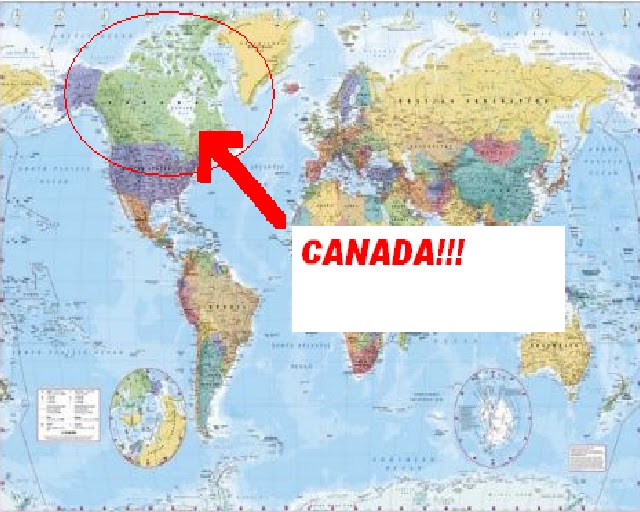
I'm fairly certain that I have mentioned my country of birth.  For those of you who haven't caught on, I'm from Canada - you know, the true North, strong and free?  The home of ice hockey and beavertails?  Still nothing?  We're better known for being the big, cold, mostly empty land mass to the north of the United States.  Ring any bells yet?


Well, there you go.  Hopefully that is a helpful visual aid.

I love Canada.  I think it's a great country; it has a beautiful landscape, is a melting pot of cultures, and, of course, everyone loves the free health care. (Except the people trying to pay off the debt it engenders - but that's a different blog entry.)

There is, however, one aspect of Canada that many could do without - the frigid winters.  Ask any Canadian you know.  It's fun to a point.  The first snowfall is always great; then come the first snow angels, the first snowmen, the first skating expeditions.  And then, of course, there's Christmas.

But after the first two months of a constant temperature of twenty below, the magic of wintertime seems to fade in a flurry of broken down cars, expensive snow gear, and frostbite.  The days get shorter, the workload gets greater, and many people are left with a pervading sense of stress and mild to severe depression.

There's no doubt that there are downfalls to winter.  For me, though, it's worth it.  Maybe that's just because I don't have a car, or have a higher rate of study halls, or am young enough to not worry about getting to work on time.  That's probably a big part of it.  But I think it's more than that.  I've had some of the best times of my life in the winter.  Hot tubbing in February, playing Said the Whale's This City's A Mess in my room while the wind whips the siding, the first Christmas my friends and I spent together - all are irreplaceable moments in my life, things I'll never forget.

So, I wish you all a happy winter.  I know it can be unpleasant, cold, and stressful, but there's beauty in it too.  Notice the beauty, and when times get tough, band together with those around you - sometimes it's during the times of greatest trial that we begin to truly appreciate the glorious world around us.

Girl With One Eye

Tuesday, November 2, 2010

The school can't even handle you right now.

Growing up, I went to a private, all-girls Catholic school.  I know what you're thinking - whoa, party!  And that would be pretty accurate.

One thing I remember most about growing up in private school was the uniform.  We had to wear very specific clothes, right down do the colour of our hair accessories.


Now, I think that to go to that extent is a bit extreme.  However, is a dress code a good idea?  Should we be implementing them in public schools?

I am the last person to tell anyone what to do, or how to dress.  Admittedly, sometimes what I see people wearing at school is so questionable that I begin to consider the positives of having a stricter dress code - those being the comfort level of the students, the lack of prejudice based on clothing, etc.

However, it is not my place - nor is it anyone else's - to tell people how to dress.  It is a person's personal decision.  Clothing has become more than just a way to cover oneself - it is a form of expression, which the administration has no right to stifle.  A strict dress code is unnecessary for a high school, which is a small-scale culture to itself.

Girl With One Eye

Monday, November 1, 2010

She doesn't do major credit cards, I doubt she does receipts. It's all not quite legitimate.

The way the Canadian government deals with prostitution in this country has irked me long enough, and I think it's time that I share some of my thoughts.

Some people with whom I have discussed this issue think that prostitutes make their own decisions.  Sure, their jobs endanger them every day.  Most prostitutes have diseases, and some of them die as a result of their profession.  But it was their choice to become prostitutes, right?  They know the risks, and they could get out and get decent jobs if they wanted to.

This simply isn't true.  Most prostitutes are controlled by a pimp: a person who sells their services, keeps almost all of the money, and enslaves the prostitutes through debt and physical force.  Often, the pimp threatens the worker's family, or the worker themselves, with death if they leave.


Canada's laws regarding this issue are incredibly backward.  Technically, prostitution is legal in Canada - it is fine to exchange money for sexual services.  However, it is illegal to keep a "bawdy house", meaning that prostitutes are unable to take care of their own safety within a safe environment.  The act of solicitation is also illegal.  All this results in is the inability of law enforcement officials to prosecute the johns, while the victims of this system - prostitutes who are often controlled by their pimps - are penalized and arrested.

That's my piece concerning this issue.  But it's only a sliver of the information out there.  I highly recommend doing more research, and formulating your own opinions.

Girl With One Eye

Wednesday, October 20, 2010

Let's go back to the coast, baby, westward to the ocean.

Water.  Clean and fresh, water is necessary for life, health, and basic hygiene.  On the other hand, not everyone in the world has access to clean water.  Is this a basic right, or an economic good?

My country has one of the biggest fresh water supplies in the entire world.  The human population uses a ridiculous amount of water, especially in the west, and one day our supply will run out.  What will happen then?  Will we begin to sell our water to the highest bidder, give it away, or store it jealously?

It doesn't even need to come to the world running out of water.  Countries have, in the past, charged their people for water.  Collecting rain water was illegal.

In my opinion, water is a basic human right.  It is necessary for survival.  We would never deprive another person of air - why do the same with water?

Anywho.  That's my piece for the day.  Happy Wednesday.

Girl With One Eye

Monday, October 18, 2010

You want to hear about the deal I'm making?

I'm assuming that all of you have heard about the Chilean miners who were recently rescued after spending seven weeks trapped hundreds of kilometres underground.  If you haven't, then...  Well, see the previous sentence for a pretty accurate summary.  Also, you've been living under a rock.


The rescue mission was a beautiful thing to watch.  Men were reunited with their families, crying, laughing, and praising God.  Then came the endless press photos, which were aired for hours all day.

One of these photos depicted the miners sporting Oakley sunglasses.  This picture was splashed all over news stations all day.  The cost of the glasses in total was $6,300.  The cost of the advertising Oakley received as a result of this was a cumulative $41 million.

Was this morally reprehensible?  Nay, say I!  This is simply Western capitalism at its best.  Come on - the beauty of family reunions and saved lives mixed with shameless product placement.  What could be more American?  I have no bad feelings toward Oakley.  Good for them.  They had to wear somebody's glasses, right?  Three cheers for capitalism!

Girl With One Eye

Friday, October 1, 2010

Thinking is overrated.

I have friends from a variety of social milieus.  A strong percentage of my friends are huge gamers.  So, unfortunately, a lot of my time when I'm with them is spent watching them game, or listening to them talk about gaming.  Usually, I'm okay with this.  Though I am much too busy and not nearly coordinated enough to be interested in video games, I'm usually all right with this.  I have become fairly well versed in game speak, and I'm sometimes even entertained by it.

However, a while ago, the enjoyment I found in this simple activity began to dwindle.  My normally sensitive friend sniped some guy in the head from a building.  "I just raped this guy!" he shouted to us all, laughing.

I was shocked.  I looked around the room.  Nobody else seemed to be affected the same way I was. Apparently, this was normal behaviour.  Referencing one of the most disgusting indictable crimes in a casual way?  No big d.  Everyday occurance.

At first, I just rolled with this kind of behaviour.  But then I started hearing it more and more.  And not just the word "rape" being thrown around like a casual activity.  I hear "gay," "retarded," "faggot," "jew," "pimp," even the "n" word, every day.  Realistically, the chances are that almost every person around you either has been raped, is gay or a minority, or knows someone who is.  One in three girls, for example, has been sexually assaulted by her senior year.  And yet a majority of people use these words, and nobody does anybody about it.  Why?

I don't have an answer.  All I know is, using these words is simply stupid and inconsiderate.  It's not okay.  And I'm going to start doing all I can to stop the use of these words.

Monday, September 27, 2010

You and me, baby, ain't nothin' but mammals.

Nudity.


So, now that that's out in the open, I suppose we can begin.  What did most of you think when I said that?  I hate to speak for everyone, but I'm assuming that most of you thought of naked people.  To go a little bit further, I'm going to assume that some of you were thinking of sexualized images.

Why do we think this way?  Why is nudity always associated with sexuality?  On one hand, the answer is obvious - most of the time people are clothed, and the naked body holds a certain mystique.  Then again, this is not always the case.  Children are often naked.  Tribal nudity is usually not sexualized.  And most people would not dream of sexualizing Michelangelo's David or the Venus of Willendorf.

I think our society is too sexualized.  Maybe that's just because my sister made me watch an episode of Jersey Shore yesterday, but I think it's more than  that.  Sex has become a focal point in our society, especially with young people.  No wonder nudity is so inextricably linked with sexuality in our minds.

Anyway.  This prompt was inspired by the article I wrote about the Dave St-Pierre show which I blogged about a while ago.  Score one for me.

All my love,

Girl With One Eye.

Thursday, September 23, 2010

I don't want to hear you kick me out, kick me out.

When I was in Grade 9, I was a little intimidated, to say the least.  I mean, it's a new school with kids and teachers I didn't know, many of whom were much bigger than me - totally understandable, right?

But I soon found that my school was full of really spirited, enthusiastic people, and I had every opportunity to get involved in a lot of great activities.  One of these was Activity Day - a day where students could participate in a range of school-facilitated activities, including laser tag, mini golf, and ziplining.  It sounded like a lot of fun - and it was.

But the next year, in Grade 10, it was decided that Activity Day would be available only for Grade 9s.  That was acceptable, my fellow classmates and I thought.  After all, we had been able to participate in Grade 9.

The next year, in Grade 11, they decided that Activity Day would be for the students in Grades 9 and 10.  We were a little disappointed, but it was something that we could get over.

This year, in Grade 12, Activity Day is for every grade but ours.

Needless to say, my peers and I are rather annoyed.  We pay student activity fees just like the rest of the school.  Why are we not allowed to participate in the same events?

The only reasons I've received so far are that a) Grade 12s have other exclusive activities such as grad trips and Prom, and b) Grade 12s often skip.

The reason Grade 12s have grad trips and Prom are that our senior year is a rite of passage, and we have earned these events through three years of dedicated servitude.  The fact that we have these events does not revoke our right to other student activities.  We still go to dances, pep rallies, etc.  Why not this?

As to the issue of Grade 12s skipping, this may have some basis in fact.  But the consequences of the disinterest of some students should not be suffered by their peers.  Besides, it's not just Grade 12s who skip - to be honest, I skipped Activity Day in the ninth grade.

To conclude, if two or more grades are involved in a school-wide activity, every grade should have the chance to participate. To do otherwise is ridiculous and unfair.

Sincerely,

The Girl With One Eye

Friday, September 17, 2010

Anticipation has a habit to set you up for disappointment in evening entertainment, but tonight there'll be some love.

Mildly alarmed?  Questioning what you're seeing?  Maybe a little afraid for my sanity?  Let me clear things up.  What you see here is, yes, a collection of naked bodies lying on a blood-covered floor - but it's also more than that.  It is, in fact, a collection of naked DANCER's bodies lying on a blood-covered floor.

I know.  What a huge difference, right?  But this is honestly a dance show.  It's a shot from Dave St-Pierre's production, La pornographie des ames - translated by the NAC as Bare Naked Souls, but literally meaning Soul Pornography.  Intrigued yet?

You should be.  Because if you weren't tipped off by the lack of clothing or the stage covered in blood, St-Pierre's artistic creation has proved to be extremely controversial.  Covering a range of topics from rape to suicide to fat jokes, this production sounds like it's trying its hardest to push the boundaries - and apparently, it's succeeding.

Dave St-Pierre, a Montreal native, has cystic fibrosis - a disease whose sufferers' average life expectancy is 37 years old. Currently, St-Pierre is 33, and pursues his dreams of exposing the grittiest, as well as the most beautiful, side of humanity with passion and perseverence.  The dancers, as well - a group of fourteen, both professional and amateur - must also be applauded for their commitment to their art.  It isn't easy to be completely vulnerable on stage, especially with something this "weird".  It takes people of true character to share their art despite what anyone thinks.

The soundtrack isn't bad, either - this mix of dance, theatre, text and video is set to music by Bjork, Coldplay, and Maria Callas, just to name a few.

Personally, I'm going to go see the show.  If you live in the Ottawa area, it's showing at the NAC from January 27-29 at 8:00 pm.  Tickets are about $30 for adults, and about half that for students.

So go see it, if you can!  I'll be reporting my reaction in February, after I see the show.

Sincerely,

The Girl With One Eye

Wednesday, September 15, 2010

Well, how the heck did you think you could beat them at the same time that you're trying to be them?

A Dozen Writing Tips

Yes, really.  Writing tips.  This is legitimately the topic today.

To be honest, I haven't read "writing tips" since I was about eleven years old, so perhaps this was a beneficial experience for me.  On the other hand, it took me about two full days to actually read it through, as my brain was constantly telling me that I had better things to do.

But let's ignore that for now, as my inability to finish the article in a timely manner may be entirely due to the ease with which I am distracted.  Though I agreed with the basic principles of what Jonathan Dube said - like being comprehensive, entertaining, and taking risks - I also think that strict rules pertaining to writing stifle a writer's voice, which is so contrary to everything I want in life that I tend to reject such rules immediately.

In conclusion, fight the power.  Resist the man.  And most of all, never, ever compromise your own unique voice, because nobody else can say things like you can.

More or less yours,

The Girl With One Eye.

Monday, September 13, 2010

I told him everything was political, and he asked me what that meant.

Well, I'll tell you what it meant.  It meant that everything about our lives, every event and action, has political implications.  Whether it's in your school, your family, or internationally, your actions have consequences.

Politics is defined as "the art or science of government or governing, especially the governing of a political entity, such as a nation, and the administration and control of its internal and external affairs."  Or at least, it is according to answers.com.  More accurately, and with more comprehensible language, politics is the way we as people decide to organize ourselves - or, in some cases, control each other.  Whatever floats your boat, right?

Wrong.  Because sometimes, through a difference of ideologies, culture, or economy, people use their politics to belittle, opress, et al, their fellow man.  Only through the efforts of free people who are able to fight inequality are people saved from opression.  It is the responsibility of the citizen to be aware of the world around them, and passionate about their love for the world.

Enter, me.  The Girl With One Eye - an eye for politics, that is!  See what I did there?  That was a pun!  Leaving aside my undeniable hilarity, let me tell you a bit about myself.  I'm a student who's passionate about politics, love, dance, music and a host of other things, and I want this blog to spark discussion.  If you have something to say, please don't hesitate to comment, or email, or whatever it is you do.  Without discussion, there's no point in expressing opinion.  I don't want to be talking to myself - I do enough of that on my own time.

This is just my intro letter - your little window into me, as it were.  My political opinions on a variety of subjects will be coming your way momentarily.  So until I experience something that sparks my interest, I will leave you.  Enjoy your life in the meantime,

The Girl With One Eye